
The renewal of rural communities depends not only on investments, but also on the ability of people to initiate actions together, undertake ventures and create local value.
The CREASSE project supports the labour market and community participation of adults at risk of social exclusion, particularly in rural areas, through the tools of the social and solidarity economy, or SSE for short. The project develops training, mentoring and community mobilisation methods that help participants to develop community-based business ideas with a social impact.

Who is it useful for?

CREASSE is for those in rural communities who want to launch not just individual enterprise development, but initiatives with a community and social impact.

  • For adults at risk of social exclusion
    It provides learning and mentoring opportunities for developing your own social enterprise ideas.
  •  
  • For adult education professionals and mentors
    Provides methodological support to those guiding disadvantaged adults through entrepreneurship or community development processes.
  •  
  • For civil society organisations and community initiatives
    It helps to connect social purpose, community participation and economic sustainability.
  •  
  • For local authorities and local development stakeholders
    It can provide new tools for activating rural communities and launching solutions based on local needs.
  •  
  • For social enterprises and social economy actors
    It makes the working models of the social and solidarity economy more visible and can initiate new collaborations.

Why is this needed?

In rural areas, the lack of jobs, out-migration and social exclusion are not just individual problems: they also demand community responses.

In many rural areas, fewer jobs, lower incomes, an ageing population, a lack of services, and the emigration of younger generations appear all at once. The challenge is not only that some people find it harder to get work, but also that there is a shortage of locally driven, cooperatively managed economic initiatives. The social and solidarity economy offers an alternative to this: models that do not operate solely on the basis of profit, but build instead on community needs, social impact, cooperation, and local resources. For Central Transdanubia, this is important because the region also contains rural and small-settlement areas where strengthening community initiatives, entrepreneurial skills, and social inclusion represents a meaningful opportunity for development.

How does the project help?

CREASSE is not simply a training project, but a community-based learning process: it helps people to identify local resources and use them to develop joint business ideas.

The CREASSE project aims to encourage the development of social and solidarity economy initiatives, particularly in rural communities and by involving disadvantaged adults. The main elements of the project:

  • mapping the social and solidarity-based economic ecosystem;
  • involving focus groups and local stakeholders;
  • exchange of European good practices;
  • development of an entrepreneurial toolkit and a facilitator’s handbook;
  • facilitator training courses;
  • A pilot learning programme being implemented in five countries;
  • community pitch events and awareness-raising activities.
The project organises green, digital, personal and entrepreneurial skills into a community learning pathway.

Practical application

The project becomes tangible when a rural community already has the idea, but lacks the joint operation, entrepreneurial know-how, and supportive framework.

Let’s imagine a small town where there is a need for a collective sales scheme for local produce, a community garden, a reuse workshop, a service to support care for the elderly, or a local initiative involving people from disadvantaged backgrounds. The idea is there, but there is a lack of financial planning, marketing, a legal structure, a framework for collaborative operation and mentoring. CREASSE can help with this: participants learn about the operational possibilities of the SSE, develop their personal, digital, green and entrepreneurial skills, work with mentors, and then present their ideas at a community pitch event. In this way, the project not only provides training but also facilitates a development process from which genuine local initiatives can emerge.

Our role

The role of KDRIÜ is to make European approaches to the social and solidarity economy accessible to rural communities and development stakeholders in Hungary.

KDRIÜ is participating in the CREASSE partnership as the Hungarian project partner. Its tasks relate to mapping the social and solidarity economy ecosystem, shaping community attitudes, utilising the results, and implementing the pilot learning process in Hungary. The project aligns well with KDRIÜ’s experience in social enterprise development, community development, adult education, rural development and the implementation of international projects. For KDRIÜ, the value of CREASSE lies in the fact that it links entrepreneurial skills development with social inclusion, community learning and local economic development.

Partnership

The CREASSE partnership connects organisations working in social inclusion, adult education, community development and social innovation. The project is implemented by 5 partners from Spain, Hungary, Italy, Cyprus and Albania.
Managing partner:

  • Acción contra el Hambre Foundation – Spain
Project partners:
  • Central Transdanubian Regional Innovation Agency – Hungary
  • Basilicata Creativa – Italy
  • SYNTHESIS Centre for Research and Education – Cyprus
  • Partners Albania for Change and Development – Albania

Are you interested in the project?

For further information, please visit the official project page or contact the project manager.

Official project page

Programme

Full project title

Status

Maturity period

Project
ID

Project participants

István Hegedűs, Senior Project Coordinator of KDRIÜ

István Hegedűs

lead project coordinator

Gábor Kinizsi, communications manager of KDRIÜ

Gábor Kinizsi

communications manager

Results and related knowledge base materials

The results of CREASSE are truly valuable when the training materials, methodologies and pilot projects give rise to community enterprise development tools that can be used locally.
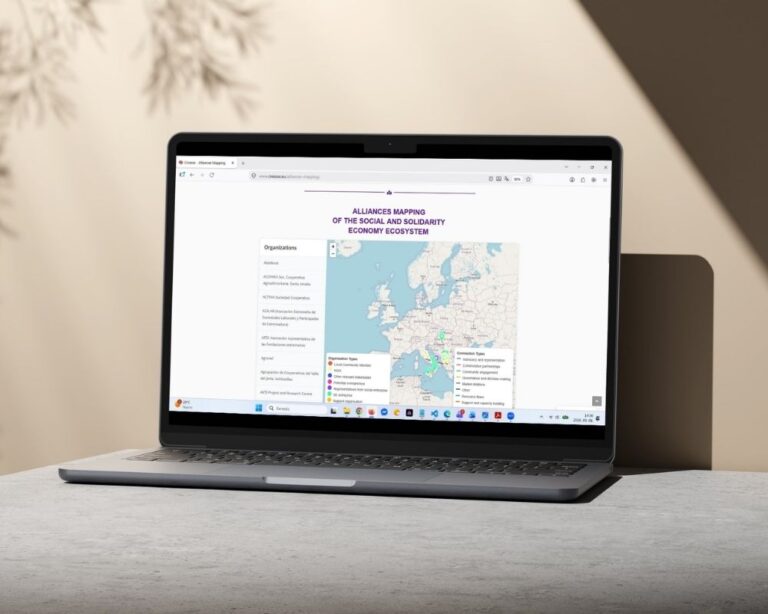
    • SSE ecosystem map
      A map illustrating the key players and links within the social and solidarity economy.
 
    • Good Practice Guide / Success Stories
      A presentation of successful social and solidarity-based economic initiatives.
     
    • Facilitator training materials
      Training materials for adult education professionals, mentors and community developers.
 
    • Pilot Learning Experience results
      Lessons learned, ideas and participant feedback from the Hungarian and international pilot learning processes.
 

Social and Solidarity Economy interactive map

Mapping of the federal networks of the social and solidarity economy.
Practical Handbook

How to manage a complex entrepreneurial activity: The role of the social moderator.
Toolkit for social and solidarity economy entrepreneurs

The CREASSE toolkit provides a practical guide for social and solidarity economy entrepreneurs and their supporters. Spanning four modules, it develops personal, entrepreneurial, green and innovative competencies through case studies and exercises.
Related communication content

CREASSE – Newsletter #3

The third newsletter of the CREASSE project (July 2026).

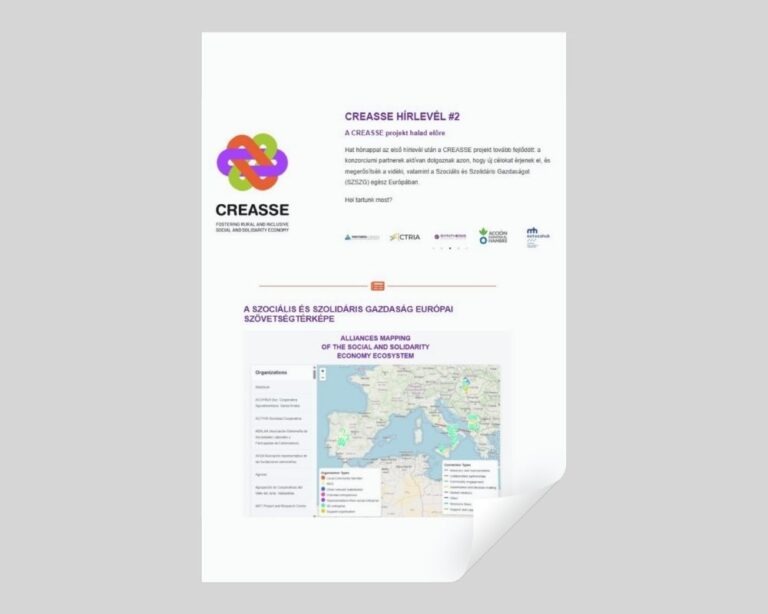
CREASSE – Newsletter #2

The second newsletter of the CREASSE project (March 2026).

CREASSE – Newsletter #1

The first newsletter of the CREASSE project (July 2025).