

A programme Dr Attila Simon, a VPresident of the Veszprém County Chamber of Commerce and Industry and Gellén László, a To the President of the Bakony-Balaton Mechatronics and Automotive Cluster following the welcome speech, professional presentations began.
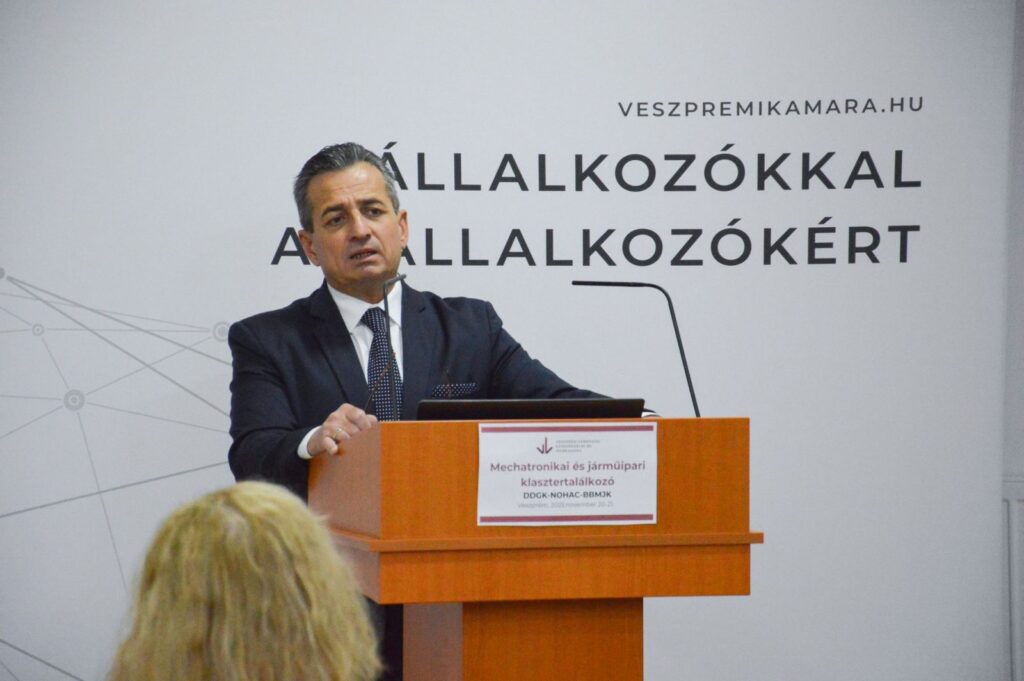
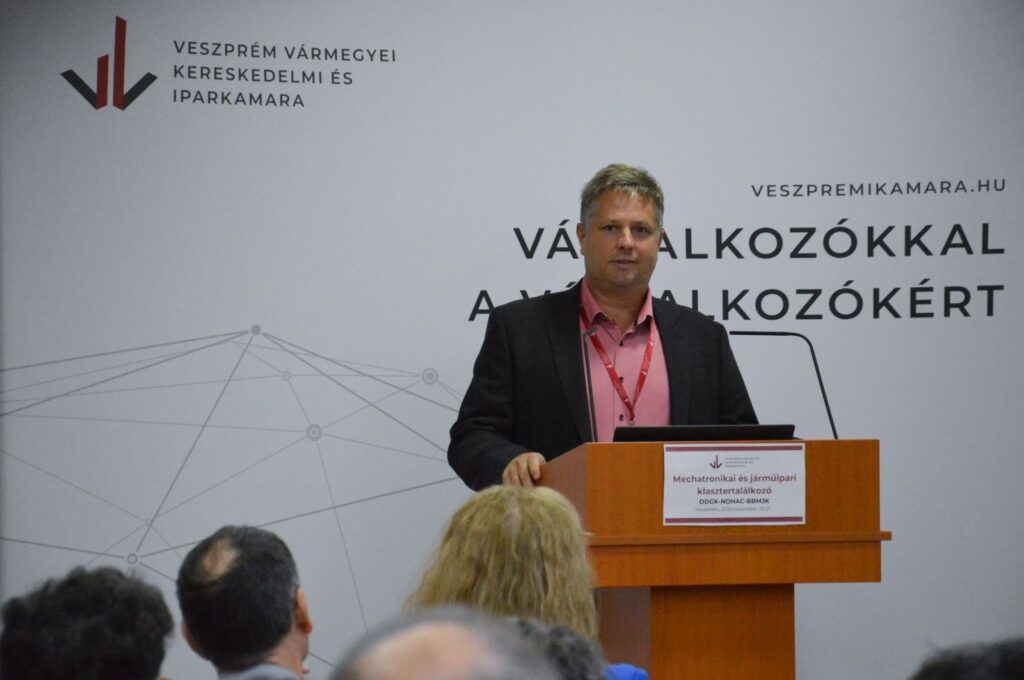
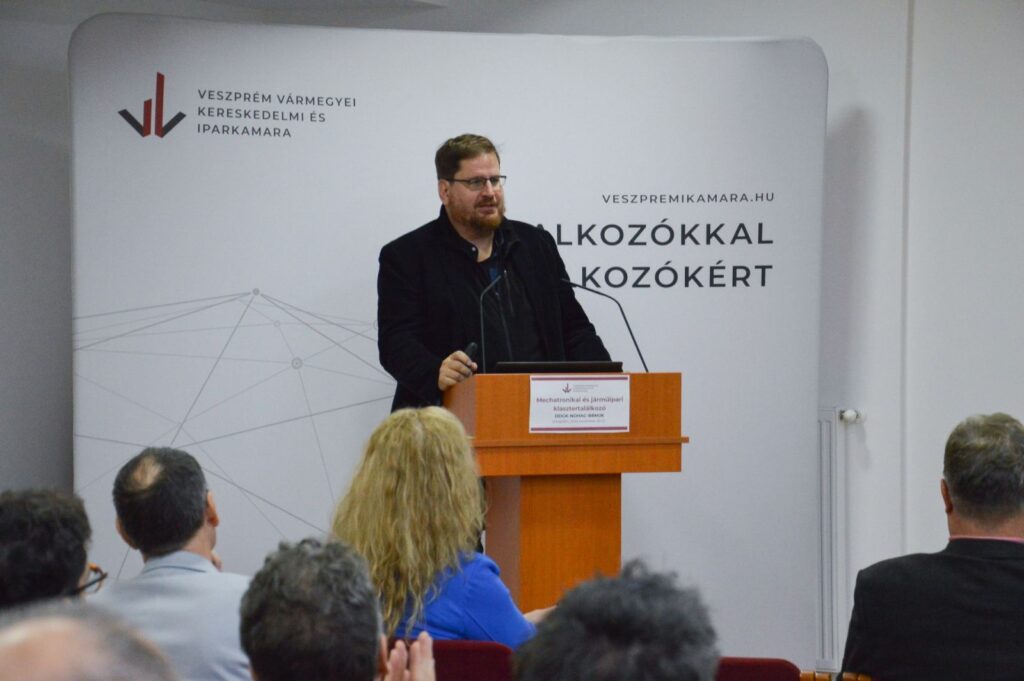
Dr Zoltán Pogátsa, economist, sociologist, habilitated associate professor, expert in international political economy He gave a comprehensive presentation on Hungary’s economic situation in 2025–26. In his presentation, he provided a wide-ranging, structured analysis of the country’s macroeconomic challenges, the problems with the growth model, and the social and economic policy implications. He pointed out that, over recent decades, the Hungarian economy has predominantly followed an extensive growth trajectory, characterised by economic policies based on low wage levels, the attraction of foreign capital and the mobilisation of the labour force. According to his presentation, a significant proportion of the Hungarian population lives in financial insecurity: he emphasised that 70% of Hungarians are considered poor, and savings are highly concentrated. The weakness of the middle class points to structural problems, which could act as a constraint on economic development in the long term. Referring to the economic geography concept of the „Blue Banana”, he pointed out that Hungary has still not become fully integrated into Europe’s most competitive regions.
He then discussed the inflationary processes of the 2022–24 period in detail. According to his account, Hungary suffered Europe's largest inflation shock, which was also contributed to by the government's limited understanding and responsiveness. The housing market also experienced one of the largest price increases in Europe, which significantly worsened the housing prospects of younger generations.
One of the central elements of the lecture was the state of public finances. According to Pogátsa, the budget is falling apart while GDP is stagnating. Spiralling interest expenditure is increasing the pressure further. The presentation also highlighted that the interest rate differential, the long-term weakening of the forint (EUR/HUF), and the lack of EU funds represent significant risks.
Investment activity in the corporate sector is plummeting, whilst German industrial production – Hungary’s most important economic link – is also faltering. Investment in the Chinese automotive industry is further fuelling the uncertainty. Due to high inflation and a fall in real incomes, the economic recovery has failed to take hold.
His lecture gave a comprehensive and critical picture of the state of the Hungarian economy for 2025–26. He pointed out that macroeconomic challenges – inflation, falling investment, budgetary imbalance, human capital issues – are jointly keeping the economy under pressure.
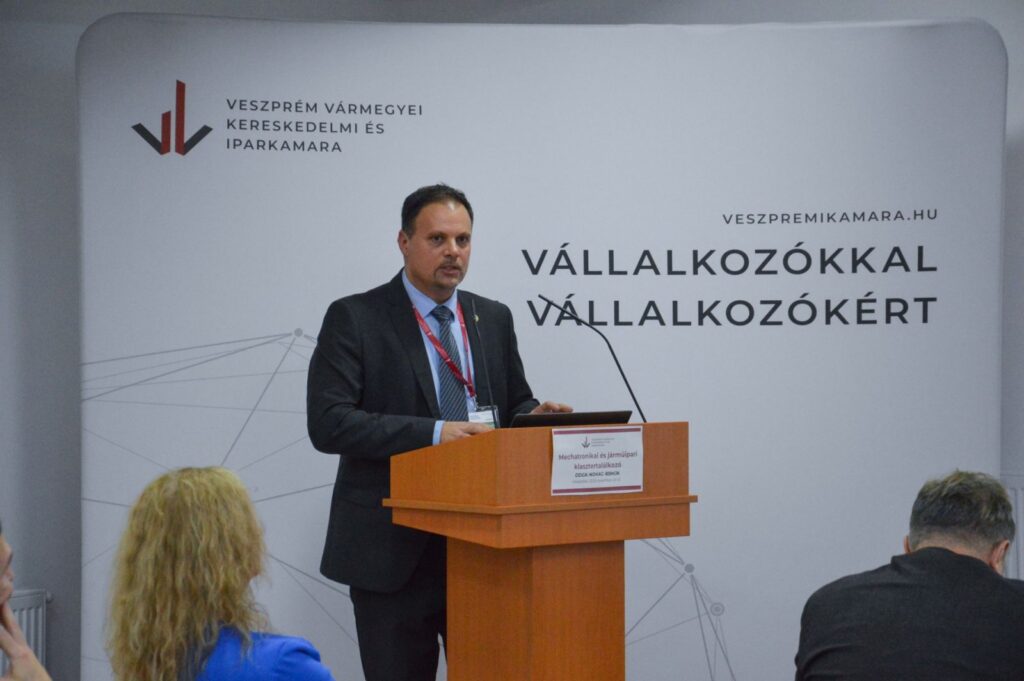
The second speaker of the mechatronics and automotive cluster meeting Sándor Pató, a Managing Director of Silver Frog Informatika Kft. One speaker gave a practical, operations-focused presentation on the challenges of modern industrial maintenance and the solutions offered by digitalisation and artificial intelligence. His key message was that, whilst industrial companies are constantly scaling their workforces and supply chains, maintenance still does not receive the attention that the risks would warrant.
In his presentation, he pointed out that the operating rhythm of the industry has radically transformed in recent years. While previously companies adapted to „STOP and GO” situations, in 2025 they had to contend much more with the „GO and STOP” phenomenon: in other words, uncertainty is greater and planning is more difficult.
The main reasons for the changes are:
- the previous 4-shift production has dropped to 2.5 shifts,
- numerous projects have been suspended or cancelled,
- the following were damaged supply chains, and a persistent shortage of components has arisen,
- companies have shifted to an increasingly aggressive cost-cutting mode,
- the future of electrification in the automotive industry is uncertain,
- China has changed from being a major buyer into the largest competitor.
Undermaintaining is a financial, technical and human risk. While KPIs often „look good” on paper, the speaker pointed out that these values automatically improve when production decreases. The speaker also presented a practice-oriented action plan that can be implemented within 90 days and is applicable to any industrial company.
In the second half of the presentation, he explained how artificial intelligence and machine learning can be gradually integrated into maintenance processes.
A vision for the future of maintenance:
- preventative maintenance in a flexible, condition-based system,
- Machine learning-based predictive learning models,
- AI-powered work organisation and prioritisation,
- real-time, automatically updating KPIs,
- full alignment with the changing demands of production.
The message of the presentation was clear: the digitalisation of maintenance and the integration of AI are no longer the future, but a prerequisite for the viability of industrial companies.
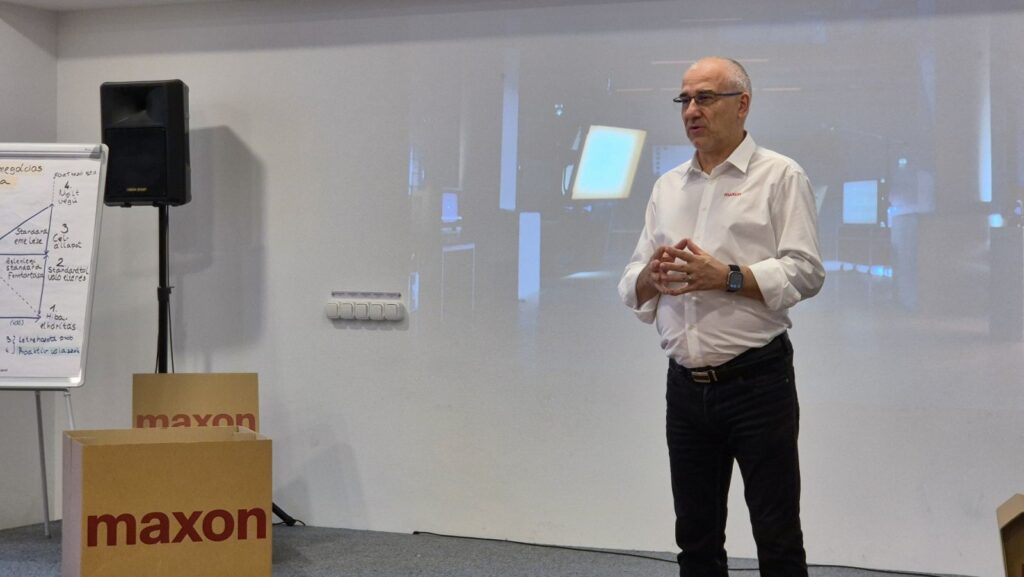
In the second half of the afternoon, the participants visited the maxon motor Hungary Ltd. to its Veszprém site, where Attila Szalai managing director presented the company’s history, profile and operations. The Hungarian subsidiary of the Swiss parent company was established in 2001 and now employs between 440 and 450 people working in two shifts, with nearly 100 female employees in the % department, due to the precise and meticulous nature of the work. The company’s specialisation is highly specialised: it manufactures ironless electric motors. These are used in applications where precision and reliability are particularly important: in medical devices (laboratory equipment, ventilators), optical equipment, cash machines, and even in aerospace applications. Some of the products from the Veszprém plant are also used in NASA projects – for example, in Mars rovers.
The company’s operations cover the entire production chain, from procurement through manufacturing to logistics. It is also investing in digitalisation initiatives: HR processes are being automated (e.g. performance appraisals, reception) to make operations more efficient.
Maxon also functions as a dual training provider, and flexible forms of employment are also present regarding the employment framework.
Health awareness, knowledge-building and intergenerational cooperation are given particular emphasis within the company’s management. The factory also supports employees’ wellbeing through compulsory daily spinal exercises, which participants were able to join in with during the factory tour, after which they were able to see the production process in action and even try their hand at certain work processes.
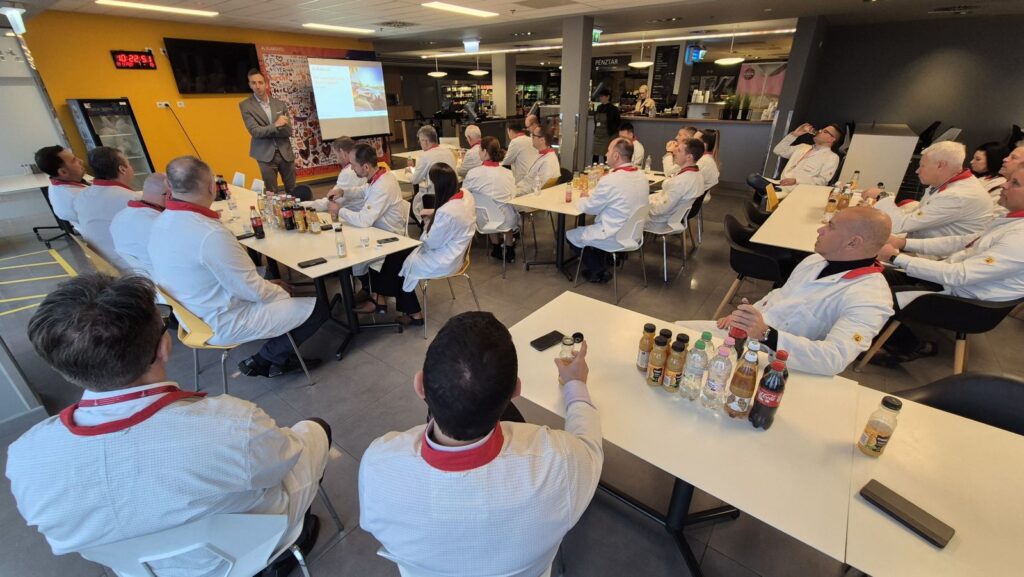
On the second day of the meeting, the organisation changed its name on 1 September 2025 AUMOVIO The programme continued with a visit to the Veszprém site and Gyulafirátót test track of the company (formerly Continental Automotive). András Mészáros, the Managing Director of AUMOVIO Hungary Kft. he outlined the company's history, activities and business directions.
During the visit, participants also viewed the production department and the laboratory. Automated production lines with modern online tracking were presented, and participants could also familiarise themselves with predictive maintenance (e.g. thermal imaging, ultrasonic testing) and additive manufacturing (carbon-fibre 3D printer — e.g. printing spare parts) processes, which significantly contribute to increasing production efficiency and customer satisfaction.
The company also features an analysis laboratory, where industrial X-ray equipment is used, among other things, for the non-destructive assessment of internal inclusions and contamination, while the presence of potential air leaks can be detected using an ultrasonic camera. In addition, external influences (vibration, heat, corrosion, salt spray, ageing, pressure changes) can be effectively simulated with the help of a test laboratory, meaning that R&D&I activities are also outstanding.
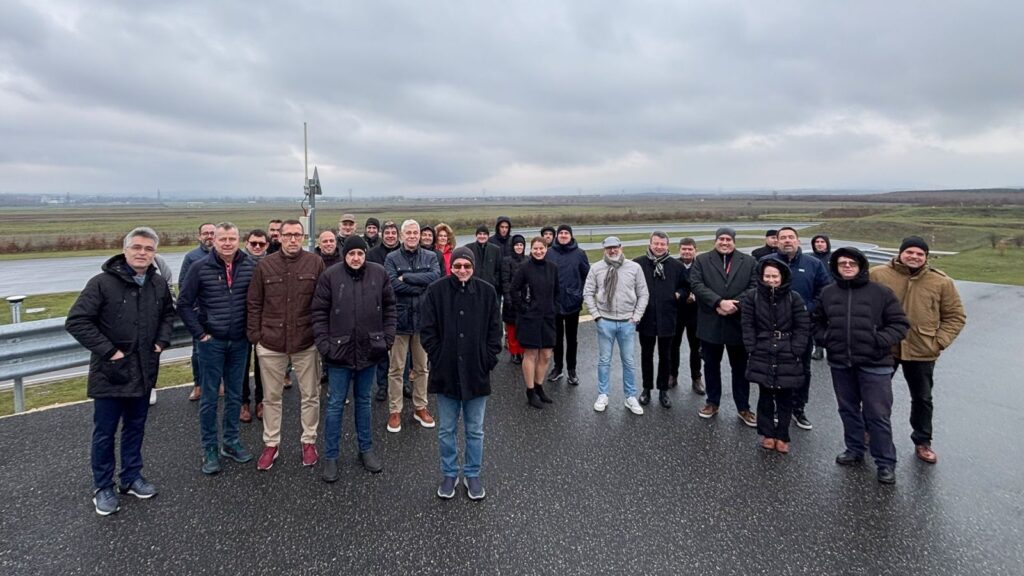
During the visit to the test track, several demonstrations showcased the safety benefits of modern driver assistance systems.
During the cluster meeting, participants not only listened to theoretical presentations, but also gained direct insight into the operations of two prominent automotive and mechatronics players in Veszprém. The presentations – covering the topics of Dr Zoltán Pogátsa and Sándor Pató – provided a solid foundation for the context: the economic situation, industrial trends, maintenance, and AI. The Maxon plant visit highlighted the domestic operations of a high-profile company manufacturing precision motors, whilst AUMOVIO’s professional programme demonstrated how a modern electronics and sensor technology factory and development centre operates in alignment with the future of the automotive industry.
For further information: www.bbmjk.hu
The event was organised by the Veszprém County Chamber of Commerce and Industry within the framework of the agreement entitled “In Alliance with Enterprises” between the Government of Hungary and the Hungarian Chamber of Commerce and Industry and the related Enterprise Development Programme.