
In elderly care, technology really helps when it provides safety and at the same time preserves a person's dignity.
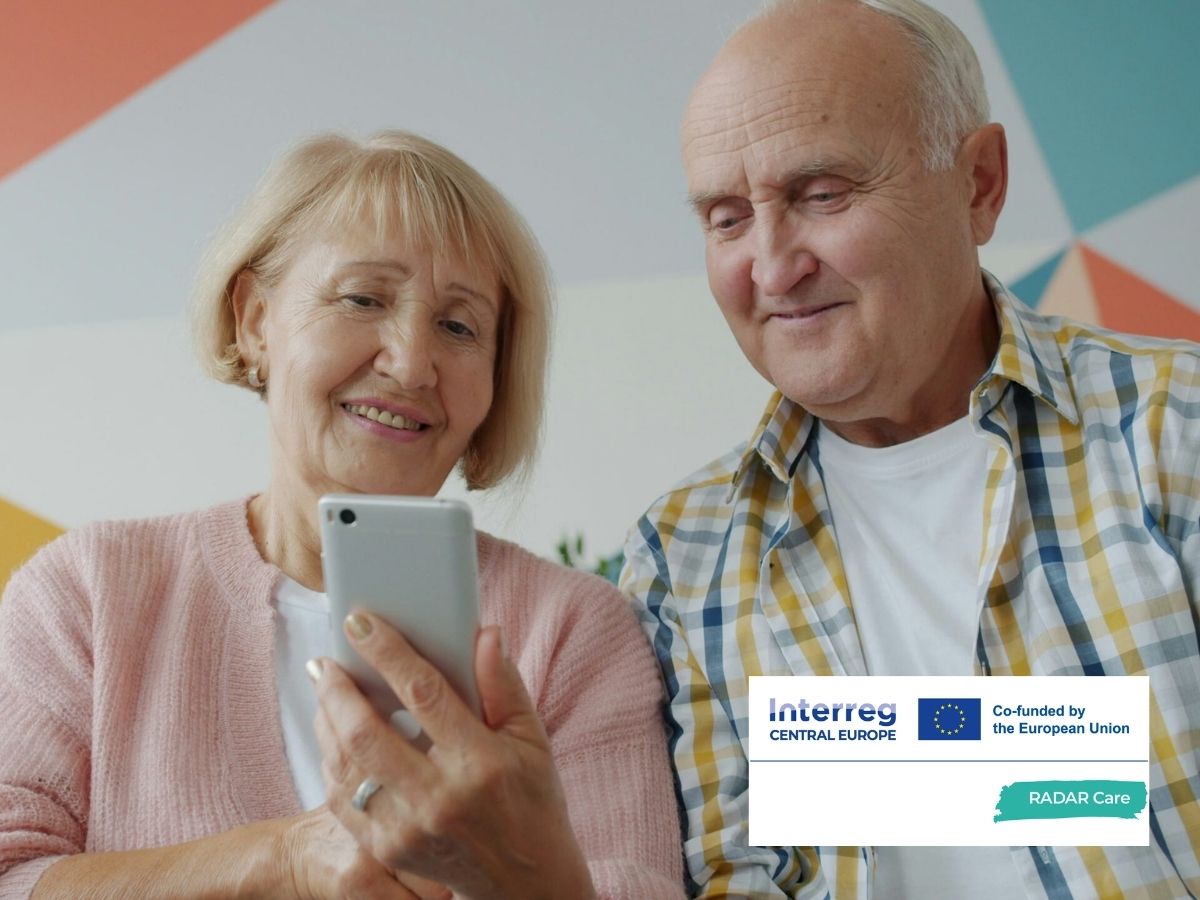
Two women and a man in their sixties are watching the screen of a mobile phone.

More and more older people want to live safely and independently, while family members and caregivers also want to be informed in time if help is needed. However, there is growing pressure on care services, and innovative solutions are often only available in one country or institution. RADAR Care – Resilient Assistive Detection & Responsive Care Cross-border Innovation Capitalisation Framework for ethical and human-centred elderly-care solutions – combines the proven methodological and technological results of previous European projects. The project develops, on the one hand, an integrated, user-centric innovation methodology that supports the ethical and efficient implementation of new technologies in elderly care, and on the other hand, develops and tests a solution that combines radar detection and smart textiles to support care in a way that respects the private sphere, further in four Central European countries. The lead partner of the project is the KDRIÜ. The joint work carried out in the four countries examines how the solutions can be applied in different care and regulatory environments.

Who is it useful for?

RADAR Care is for those who want to create safer, human-centered senior care and are looking for tried-and-tested, easy-to-implement solutions.

  • For the elderly and their family members
    The goal of the development is to promote safety and independent living while respecting the private sphere.
  •  
  • For caregivers and care providers
    Joint testing can reveal how perception can be integrated into everyday work processes and when it can help achieve faster responses.
  •  
  • Municipalities and policy-makers
    They can obtain comparable experiences and guidance for the implementation of digital care solutions.
  •  
  • For researchers and technology companies
    Real user feedback, common evaluation methods and application frameworks tested in several countries can help their development.
  •  
  • For patient and advocacy organizations
    They can participate in ensuring that ethical, data protection and user-related aspects are applied throughout the development process.

Why is this needed?

The challenges of long-term care are similar in many countries, but the testing and adoption of new solutions are hampered by different rules, operating procedures, and digital readiness.

Due to an aging population, the scarcity of caregiving capacities, and the growing demand for long-term care, there is a need for tools that support the work of caregivers and respect the decisions and dignity of older adults. Previous European projects have already developed usable laboratory methods, digital health guidelines, collaboration models, and smart textile-based experiences. However, these were developed in separate projects and in different national contexts. RADAR Care helps by jointly developing these results, coordinating testing, and addressing data protection, ethical, and organizational issues so that the working solutions can be applied beyond national borders.

How does the project help?

The project builds on existing results and then tests them in a common framework to see how they can be used in institutional and home care environments.

The Living Lab methodology of Health Labs4Value supports testing conducted in real-world environments involving users. The DIGIVITALITY digital health guide helps prepare for the application of innovation. The COOP4HEALTHCARE collaboration matrix maps the relationships between stakeholders, and the Smart Care Assist results provide lessons learned from the use of smart textiles in care. This is based on the ethical, human-centered innovation framework and the solution that combines radar sensing with smart textiles. The partners are designing and evaluating two international pilots according to the same principles: one in institutional care and one in a home care environment. In addition to technical functionality, the tests also examine usability, compliance with care workflow processes, data protection, and user experience. The decision on the later implementation of the solution can be made based on the results and local conditions.

Practical application

RADAR Care can be useful when caregivers receive relevant information in a timely and reliable manner, while the elderly person's privacy remains protected.

Imagine a home care provider that wants to better track when interventions are needed, but does not want to use cameras in the residents' rooms. A combination of radar detection and smart textiles could be a possible alternative. In this project, this possibility is being tested by involving caregivers and those involved, using common ethical and evaluation criteria. The pilot can reveal which signals are useful, how data can be handled, and under what conditions the system can be integrated into the existing care process. This is an illustrative application situation, not a proven clinical or operational result; the technology does not replace personal care.

Our role

The KDRIÜ will act as the lead partner and will coordinate the methodological and implementation work of the four countries and organize the trial in Hungary.

The KDRIÜ is responsible for the strategic and administrative coordination of the project. It leads the development of a common framework for ethical and human-centered care innovation, which also uses the living laboratory results of the previous Health Labs4Value project. In the technological development, he supports the implementation of usability and ethical aspects. In the Hungarian pilot, he is responsible for involving care providers, preparing the site, testing, and collecting feedback. These results are built into the joint evaluation and the long-term implementation plan.

Partnership

The RADAR Care consortium of six partners is composed of organizations from four countries. The partnership includes innovation agencies, higher education and research institutions, and care service providers.
Managing partner:

  • CTRIA – Central Transdanubian Regional Innovation Agency Nonprofit Ltd. – Hungary
Project partners:
  • University of Applied Sciences Upper Austria, Research & Development – Austria
  • VSB – Technical University of Ostrava – Czechia
  • Carinthia UAS – non-profit limited liability company – Austria
  • DEX Innovation Centre – Czech Republic (communication coordinator)
  • Institute for Older Care and Sheltered Homes – Italy

Are you interested in the project?

For further information, please visit the official project page or contact the project manager.

Official project page
Logo of the RADAR Care Interreg Central Europe project

Programme

Full project title

Status

Maturity period

Project
ID

Project participants

István Hegedűs, Senior Project Coordinator of KDRIÜ

István Hegedűs

lead project coordinator

Results and related knowledge base materials

The planned results of RADAR Care are tested together with the knowledge from previous projects and are transformed into actionable solutions. The materials are produced during the implementation process.

An innovative and ethical framework applicable across borders
Common guidance for involving, protecting and evaluating users of time-management technologies. A pilot-validated solution that works with radar and smart text
The development and evaluation of integrated technology in different care environments. Two international pilots
Co-developed trial in institutional care and home care with the participation of four countries. RADAR Care strategy and sustainability action plan
A material that transforms the lessons learned by pilots into long-term collaboration and application proposals. Training and communication materials
Professional guides, presentations and summary reports for caregivers, decision-makers and developers.

Related communication content