
Digital development only represents a true advantage if our systems, services and communities are resilient against cyber threats.

The digital transition is now part of the daily operations of businesses, public institutions, local authorities and citizens. The more services, data and processes that move into the digital space, the more important it is for them to operate securely and in a crisis-resilient manner. The aim of the CAMPUS – Digital campuses for European resilience project is to help European regions ensure that a region, institution or community is able to resist digital threats, manage disruptions and then rapidly restore its operations. Starting from the example of the Brittany Cyber Campus, the project examines how regional cooperation models can be established among cybersecurity actors, businesses, public institutions, universities and decision-makers.

Who is it useful for?

CAMPUS is for those who treat digitalisation not only as a development opportunity, but also as a security and operational responsibility.

  • For businesses and SMEs
    It can help ensure that digital developments go hand in hand with safer operations and more informed cybersecurity decisions.
  • For local authorities and public institutions
    It can provide good practices and cooperation models to strengthen the security of digital public services.
  • For digital and cybersecurity service providers
    It can make the regional professional community more visible and open up new domestic or international collaborations.
  • For universities and training providers
    It offers a connection point for digital skills, cybersecurity training, research and innovation.
  • For decision-makers and policy actors
    It helps to understand how digital resilience can be built into regional development tools.

Why is this needed?

Digitalisation only strengthens regions if the security of services, data and systems develops at the same time.

The digital transition is not merely a technological issue. Businesses, public institutions and citizens are using an increasing number of digital services, whilst cyber threats, data security risks and digital vulnerabilities are also intensifying. For regions, one of the greatest challenges is to ensure that digitalisation does not increase exposure, but rather results in safer and more crisis-resilient operations. For this, isolated technological solutions are not enough: cooperation is required between the public sector, businesses, universities, research institutes and digital service providers. This is particularly important for Central Transdanubia, as the region's economy is strongly linked to industrial, technological and innovation processes. CAMPUS provides international good practices and policy learning opportunities for this.

How does the project help?

CAMPUS does not view digital resilience as an afterthought cybersecurity defence, but rather as a regional development and cooperation issue.

The main elements of the project:

  • exploring the digital resilience situation of regions;
  • identifying well-functioning European practices;
  • integrating cybersecurity into business development and public service development;
  • development of campus-type regional cooperation models;
  • development of policy instruments for digital resilience.
The project is also linked to the EU's digital and cybersecurity objectives, as well as to preparation related to the NIS2 Directive.

Practical application

The project becomes tangible when a business or public institution is facing digital development while also needing to manage security risks.

Let us imagine an SME that wants to introduce a new customer management system, online ordering interface or production management solution. The development is important for the business, while data protection, supplier and cybersecurity issues also arise. In such a situation, CAMPUS can help the business to connect more easily with experts, support organisations and a regional ecosystem where digitalisation and cybersecurity appear as mutually reinforcing development areas. Thus, digital development means not only the introduction of a new system, but also a more conscious, secure and resilient operation.

Our role

The role of KDRIÜ is to make the European experiences of digital resilience comprehensible for businesses, institutions and development actors in Central Transdanubia.

KDRIÜ is participating in the CAMPUS project as a project partner and communication lead. The organisation is working on the development of the Central Transdanubian digital resilience ecosystem while also coordinating international project communication. From the perspective of the Hungarian connection, the Central Transdanubian S3 strategy and DigitalTech EDIH are important, contributing to the region's preparedness through services, training and expert support that foster the digital development of businesses and public institutions.

Partnership

The CAMPUS partnership connects different European regions, development organisations, universities and cities to strengthen digital resilience. The project is implemented by 10 partners from 7 countries.
Bretagne Next – France, lead partner Project partners:
Brittany Regional Council – France
North-East Regional Development Agency – Romania
Digital Innovation Zone – Romania
Regional Government of Tuscany – Italy
Tampere University of Applied Sciences Ltd – Finland
Central Transdanubian Regional Innovation Agency – Hungary
City of Rijeka – Croatia
Council of Tampere Region – Finland Discovery partner:
Regional Agency for Development and European Integration Belgrade – Serbia

Are you interested in the project?

For further information, please visit the official project page or contact the project manager.

Official project page

Programme

Full project title

Status

Maturity period

Project
ID

Project participants

Viktor Hegedűs, Senior Project Coordinator of KDRIÜ

Viktor Hegedűs

lead project coordinator

Gábor Kinizsi, communications manager of KDRIÜ

Gábor Kinizsi

communications manager

Results and related knowledge base materials

The CAMPUS results are truly useful when digital resilience is not an abstract cybersecurity goal, but rather knowledge and a cooperation model that can be used by regional actors. The project's results will expand continuously as the work progresses.
Regional situation analysis / SCORE analysis
Exploring the current state, strengths, challenges and directions for development of digital resilience. Collection of good practices
European examples in the fields of cybersecurity ecosystems, digital campuses and resilience solutions. Questionnaire surveys
Surveys on risk perception and solutions related to the use of digital services. Road to Policy Improvement
The partners' policy development journey for strengthening digital resilience. CTR CAMPUS concept
The planned model of the Central Transdanubian digital resilience cooperation platform. Communication materials
Project videos, posts, infographics, project presentations and event communication content.

Related communication content

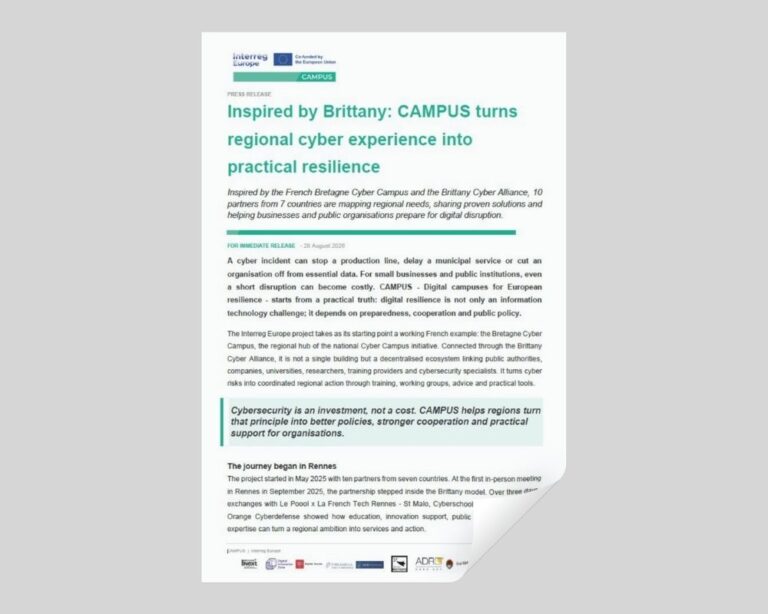
CAMPUS – Press Release #1

The first press release of the CAMPUS project (August 2026).

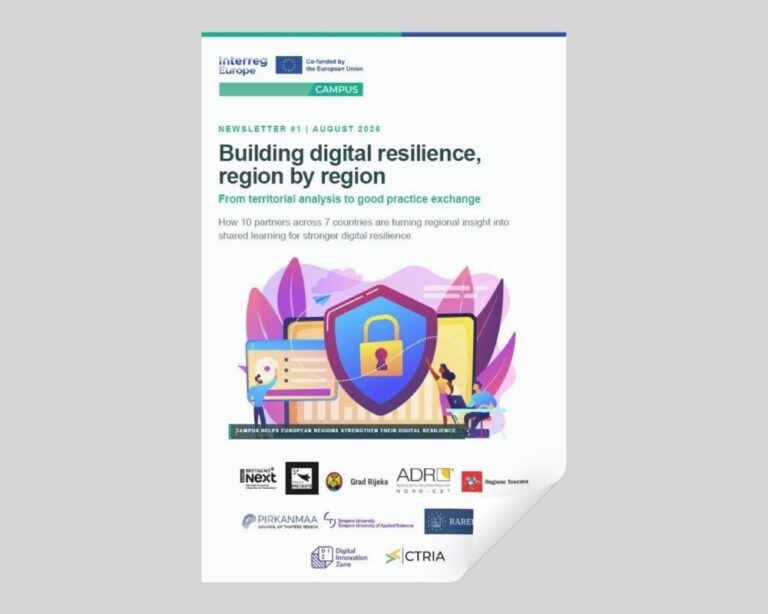
CAMPUS – Newsletter #1

The first newsletter of the CAMPUS project (August 2026).

CAMPUS project video

The CAMPUS project promotional video.